To use reading notes, choose an idea connected to a current problem, preserve its source and your interpretation, and arrange a small trial. Add what happened afterward. The note then holds both the reading and the experience of applying it.
You do not need to turn an entire book into tasks. Choose one decision or step you want to improve. A limited application makes it easier to see where the source ends and your own judgment begins.
Separate the source from your application
For example, use Atul Gawande’s The Checklist Manifesto as reading material. Record the actual edition and chapter or location. Keep a direct quotation distinct from a paraphrase.
READ-01 applies the checklist idea to a project meeting: identify decisions, check materials, and confirm next actions. These are the reader’s proposed steps for this setting, rather than a quotation attributed to the author.
Pick a situation coming up soon
The next meeting has decisions to make, which gives the trial a clear setting. A meeting held only to share updates may need different checks. State the condition so the application has a boundary.
Schedule “send decision questions and materials before the meeting” instead of “learn to run better meetings”. Decide what to observe, such as missing materials discovered early, before judging the trial.
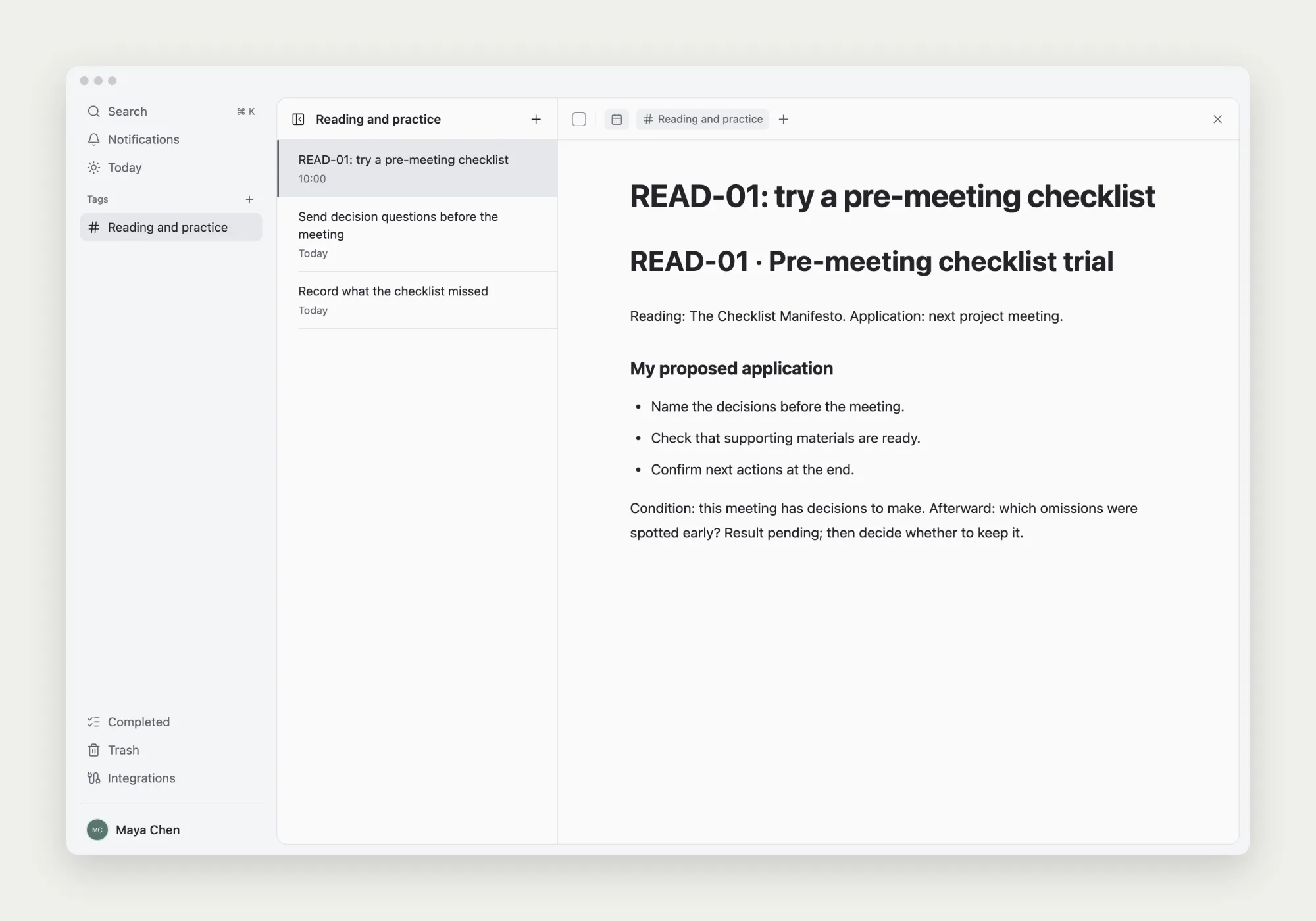
Return the experience to the note
In TodoNote, tags can gather the reading record and practice tasks. Keep the source and application reason in the trial note, then add the observation after the meeting before extracting a reusable method.
If the discussion still drifts, check whether the checklist was used, materials were ready, and questions were clear. Record an explainable difference and choose one adjustment instead of treating the whole idea as settled.
Keep the result with its conditions
Participants, topics, and preparation can also affect a meeting. Concrete observations are more useful than “this method works” because they preserve what you actually saw and the context for another attempt.
Book / author / edition:
Chapter or location / source:
Source point and my interpretation:

Current problem:
One idea to try:
Conditions / exclusions:
Specific trial:
Date / materials:

What to observe:
What actually happened:
Keep / adapt / drop, and why:
Conditions for another use:After repeated use, stable checks can become an SOP built from work notes. Keep exploratory ideas as questions and trials until there is a reason to make the process more definite.