When notes disagree, check whether they concern the same version, entry point, account conditions and time. Trace original evidence and test the claim needed for your present work. Keep unresolved disagreement explicit; a newer edit date alone is not a reason to overwrite another record.
“CSV only” and “XLSX supported” seem incompatible. If they describe different import entries, the missing information may be their scope.
Put each claim back in context
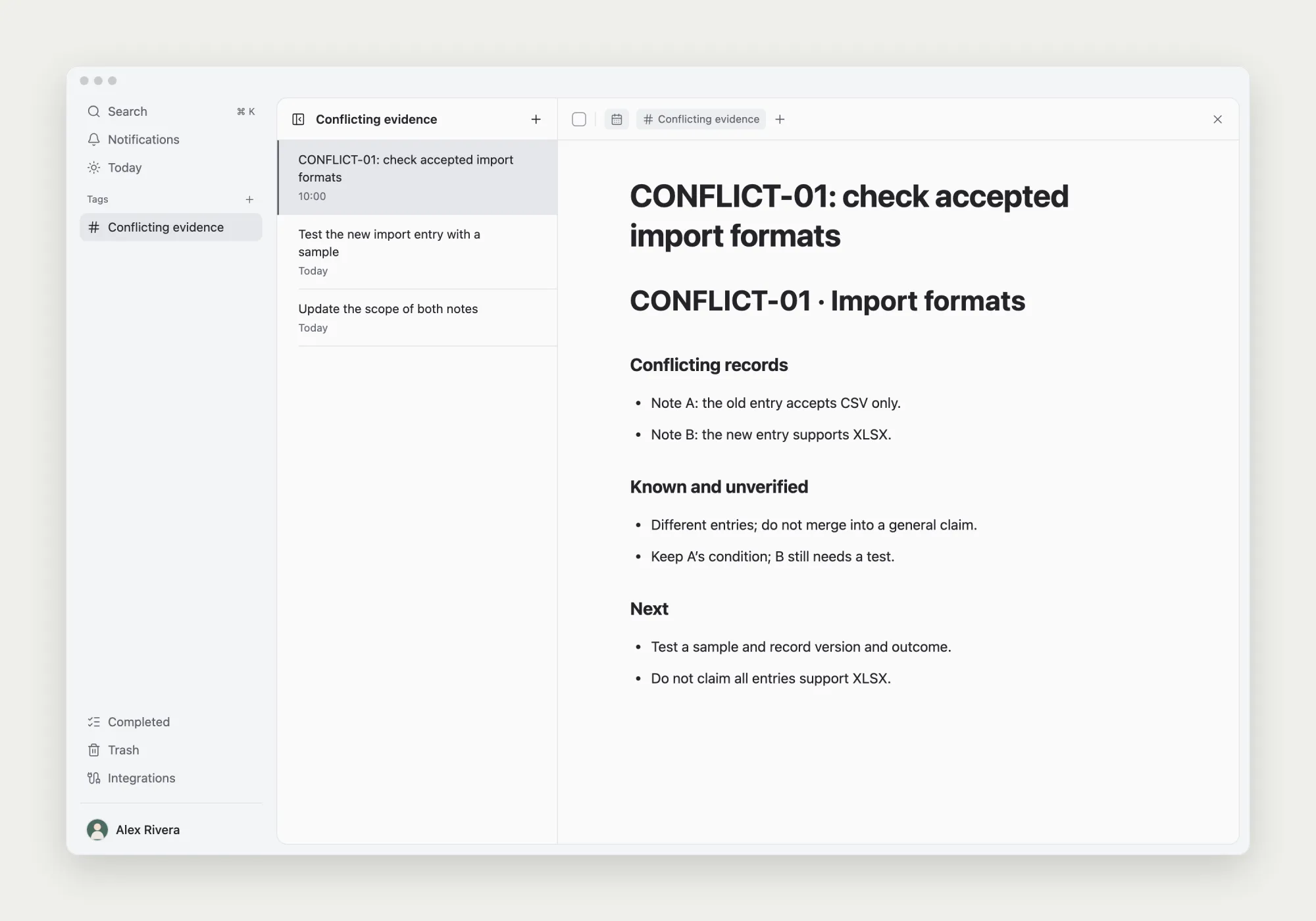
CONFLICT-01 compares an old-entry screenshot with an excerpt from a new-entry demonstration. Different sources could explain the discrepancy, but a demonstration excerpt does not yet verify the new entry for your file.
Preserve both original statements and their evidence locations. Add the scenario you currently need rather than rewriting one note as a rebuttal before checking.
| Check | Note A | Note B |
|---|---|---|
| Entry point | Old import entry | New import entry |
| Evidence | Screenshot and operation record | Demonstration excerpt; not tested |
| Current treatment | Keep the old-entry restriction | Schedule verification of the new claim |
Why the newest date is not enough
An edit date might reflect a wording change. A summary may omit account restrictions. Ask what supports the claim, whether its conditions match your task and what observation could resolve it.
The records concern different entries. Whether the new one accepts this file remains unverified; do not broaden its scope yet.
Test the smallest useful question
Use a sample without real business content in an authorized test environment. Record the entry, version, file conditions and outcome. If testing is unavailable, use the confirmed route for current work and retain the open question.
In TodoNote, put both note locations in a verification task and group records with a topic tag. Save reasoning in the verification note, then update the original notes with their applicable conditions.
Repair the paths readers still use
After verification, check whether the old claim remains in frequently used instructions. Preserve content that still applies to an older environment and identify the replacement where appropriate.
If evidence remains inconsistent, name the unresolved part and the evidence needed next. An accurate boundary is more useful than a falsely definitive answer.
Related practice: How to Maintain a Personal Knowledge Base and Spot Outdated Notes