Folders give a note a primary home. Tags give the same note several retrieval paths. Choose by the questions you expect to ask later: if you deliver projects and reuse lessons across them, a project home plus a few topic tags can serve both needs.
“Where does this belong?” can be a surprisingly hard question. “What will I be looking for when I return?” is more useful. A signup interview belongs to today’s redesign, but its research lessons may matter long after the redesign ends.
Compare retrieval paths before choosing a tool
Here, a folder means a primary storage path and a tag means an additional classification. Apps differ: some have nested tags, shortcuts or multiple views. The comparison describes organizing choices rather than promising identical behavior in every app.
| Need | Folder approach | Tag approach |
|---|---|---|
| All evidence for one delivery | Keep a project directory | Apply a shared project tag |
| One topic across projects | Search or create reference links | Collect records through a topic tag |
| Move finished work out of daily view | Archive the project folder | Adjust project classification; keep topic access |
| Keep upkeep small | Limit directory depth | Limit duplicate tags and unnecessary dimensions |
Follow two paths to the same research
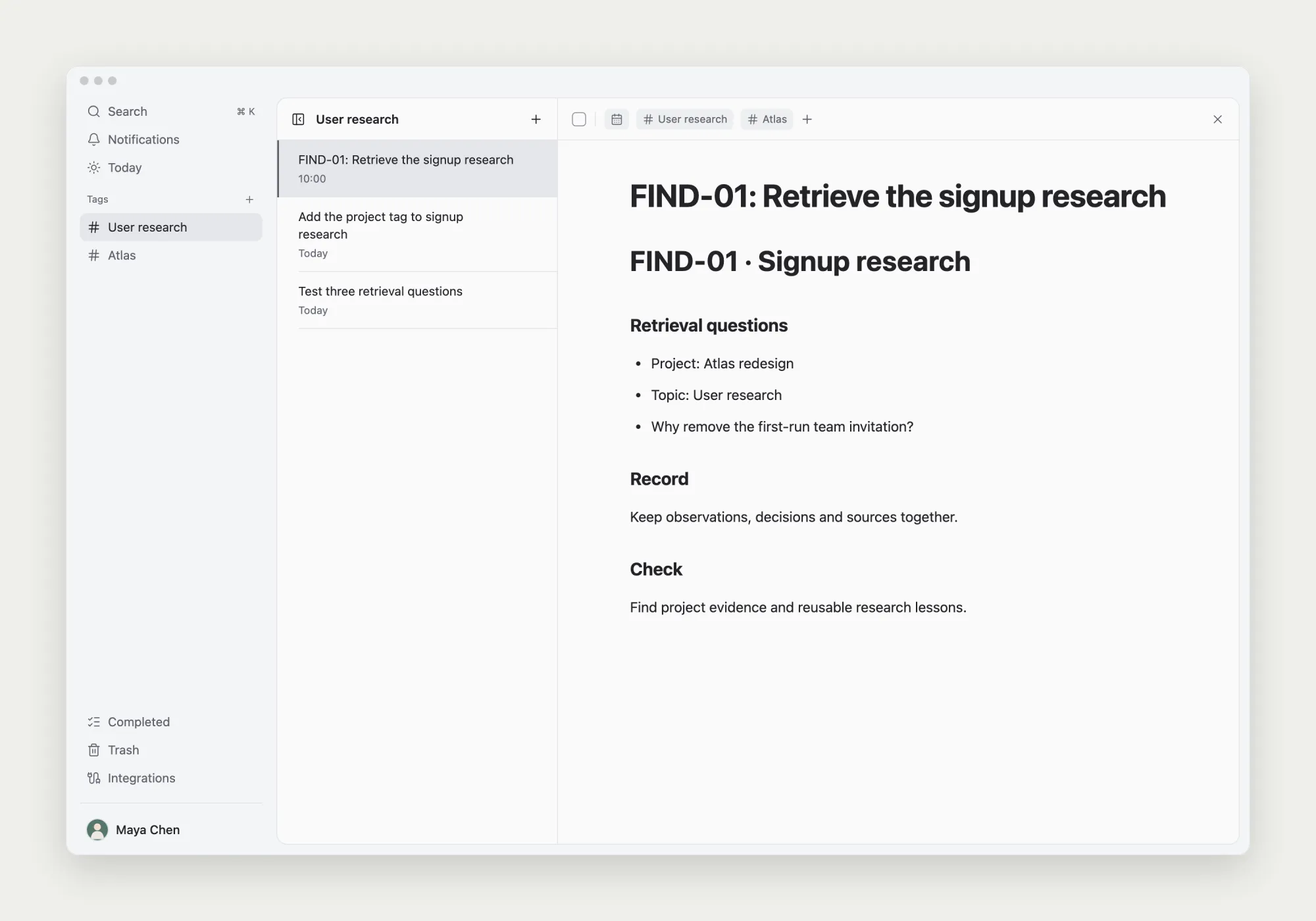
FIND-01 concerns the Atlas signup redesign. One question is why the team invitation was removed from first signup. Another is what previous research taught about a user’s first experience. The first needs project context; the second needs a topic that spans projects.
In TodoNote, keep observations and reasoning in the original interview task and apply both Atlas and User research tags. You maintain one record with two entry points. The note remains useful when the task is completed.
Avoid turning every attribute into a tag
If a title and date already identify a record, adding Friday, Third interview and To read may create more maintenance than value. Before adding a tag, name the retrieval problem it solves. A classification without a use can wait.
Project and topic classifications also age differently. A project ends; a research topic can remain useful for years. Closing the project should not erase the route to lessons that still matter elsewhere.
Test the system with three real questions
Try to find the evidence behind this project’s decision, a lesson from a comparable project, and a method you can reuse next time. Notice whether the obstacle is unclear naming, overlapping categories or a note that never recorded the conclusion.
If those questions are easy to answer, stop reorganizing and return to the work. Add structure when a retrieval need repeatedly appears, rather than maintaining a large taxonomy for needs you may never have.
Continue with: How to organize note tags when names and hierarchies get messy