A useful self-study plan starts with something you want to do independently. Work backward to the lessons, exercises, and checks that support that outcome. Keep your attempts, errors, and corrections with each exercise, then try again with different inputs. Progress becomes something you can demonstrate as well as something you have watched.
Leah is learning SQL for her operations work. Her goal is to produce a weekly sales summary: select the right dates, aggregate the orders, and explain why the result is trustworthy. Filtering, aggregation, and joins support that goal; the rest of database administration can wait for a later learning cycle.
Choose an independent outcome with a clear check
Narrow “learn SQL” to “calculate sales for a specified week from an orders table and verify it with a small sample.” Define allowed resources and completion criteria. Looking up syntax is fine for this goal, but copying a lesson’s answer is not the independent check. Explain the date boundaries and the level of detail in the data.
When choosing a course, check whether it covers the foundations this outcome needs. Its chapter order can guide your reading, while your actual gaps guide the exercises. Expand the scope after this first result is working.
| Topic | Exercise output | How to check it |
|---|---|---|
| Filtering | Orders from a specified interval | Inspect boundary-date examples |
| Aggregation | Total for three orders | Compare with a hand calculation |
| Joins | Explanation of one-to-many row counts | Count appearances of each order |
| Combined practice | Independent weekly sales summary | Change the inputs and explain the result |
Keep your attempt alongside the learning task
In TodoNote, give each exercise a bounded task and keep the source, input, query attempt, and output in its note. After a lesson, try the work before consulting the solution. Record whether the gap is unfamiliar syntax or a misunderstanding of the data relationship.
The Learning Scientists’ retrieval practice guide recommends recalling information before checking materials and trying again later. For this skill exercise, use that sequence to explain the method without the example in front of you, then check your work against the actual output.
Keep an error you can explain
Leah tests three orders worth 100, 20, and 80, which should total 200. The first order has two line items; the other orders each have one. Joining orders to items and summing the order amount counts the first order twice, producing 300.
The PostgreSQL join documentation explains that a row pairs with each matching row. Leah checks the joined row count and restores one row per order before summing. When the summary needs no item fields, calculating directly from orders is sufficient.
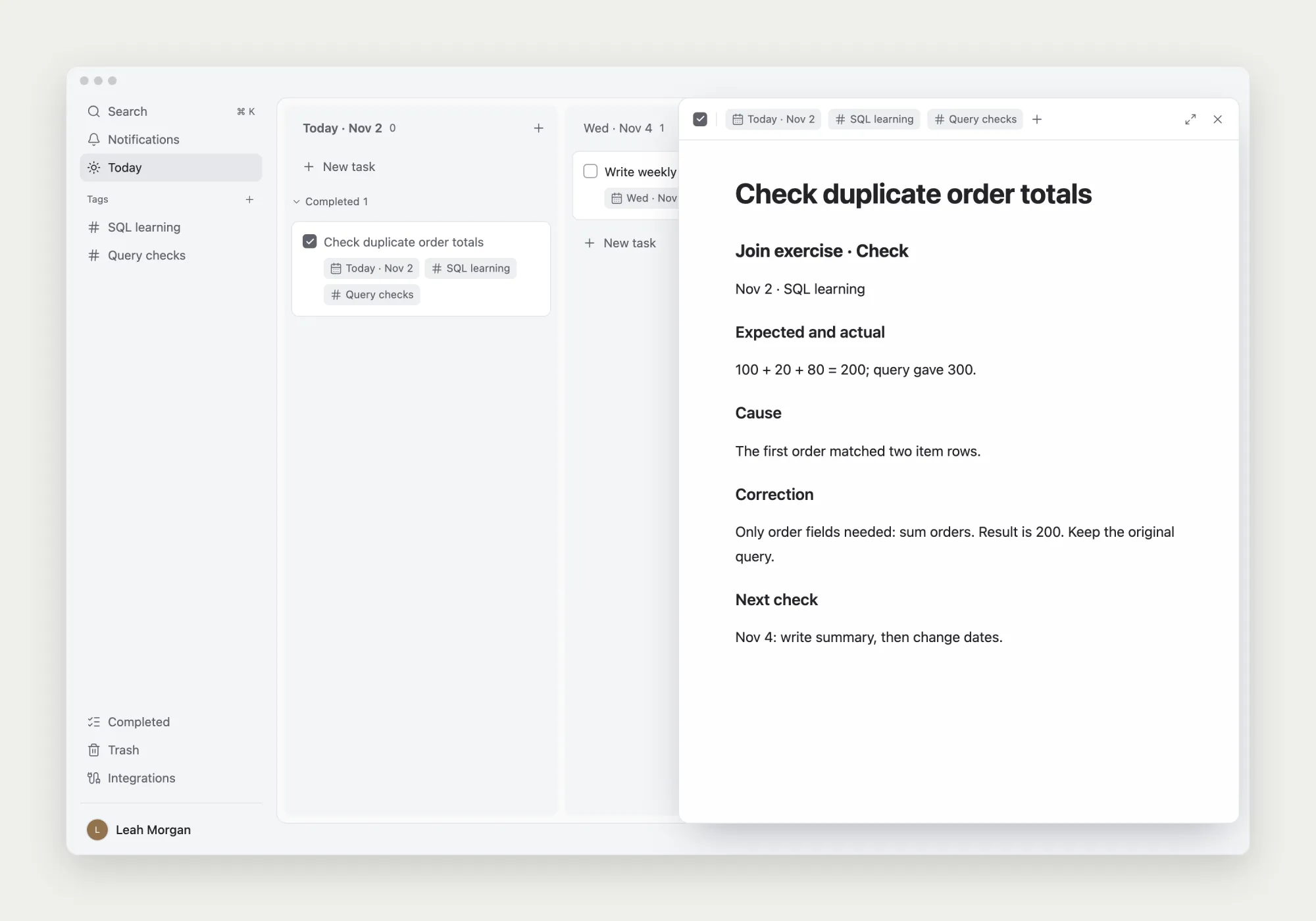
The correction needs its conditions: the amount belongs to an order, and the join changed the number of rows per order. Distinct amounts are not a general solution, because different orders can legitimately share the same amount.
A reusable self-study and practice template
Keep the overall outcome in a main task and record exercises as subtasks or separate tasks. Use only the fields that help with the current exercise.
Outcome I want to complete independently:
Allowed resources / completion criteria:
Foundations to learn / source links:

Exercise / scheduled date:
Inputs and expected result:
My attempt / saved output:
Mismatch / explanation:
Correction and when it applies:

Next independent check / date:
Inputs or conditions to change:
Result / remaining gaps:Reserve another attempt before expanding the goal
After the small-sample check on Nov 2, Leah keeps the original error and correction with the tags “SQL learning” and “Query checks.” She schedules an independent weekly summary for Nov 4 and a later check with a different date range. Completing the investigation does not complete those exercises.
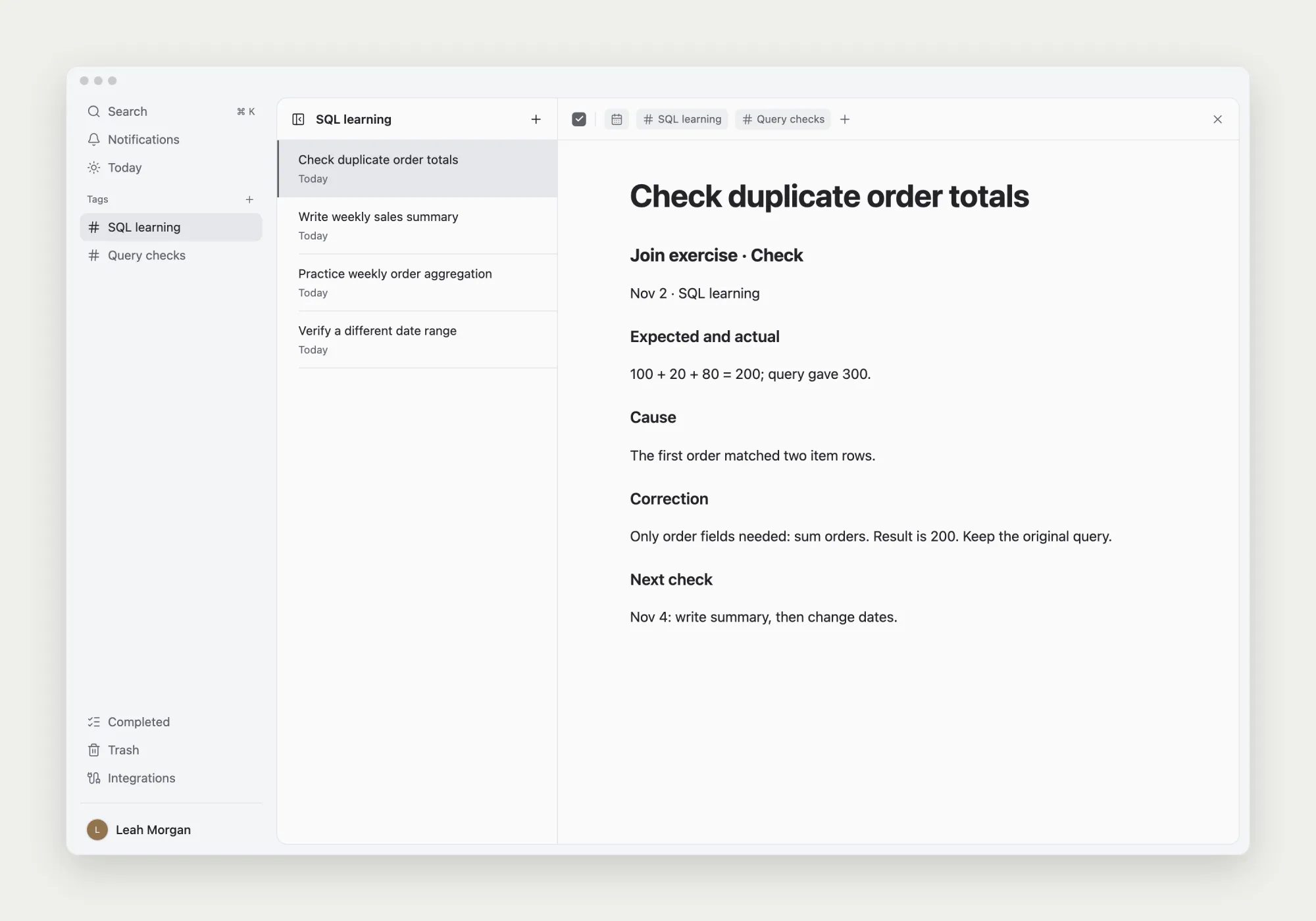
For the next check, explain the steps yourself, then consult documentation and inspect the result. If one-to-many relationships are still unclear, add a focused exercise. If you only needed a syntax lookup, there is no need to replay an entire course. Record what worked and the specific gap that remains.
For concept explanations, see the article on turning curiosity into a reusable note. Close this study cycle when you can meet its stated outcome, and use task breakdown to keep any additional practice manageable.