A product hypothesis test card states what must be true, how to check it, what to observe and which result would lead you to continue, revise or stop. Write that rule before the test to avoid moving it after seeing the result.
“People like the new page” is difficult to test precisely. Asking whether target readers can explain eligibility produces a clearer task and observation.
Connect the hypothesis to one risk
Strategyzer's Test Card connects a hypothesis, test, measure and threshold. Here the risk is unclear photography-course eligibility. Pricing, appeal and conversion are separate questions requiring their own evidence.
Recruit people close to the intended audience and avoid instructions that reveal the answer. Ask them to read and restate the conditions rather than simply asking whether they understood. Purchase intent requires different evidence.
Preserve the rule written before observation
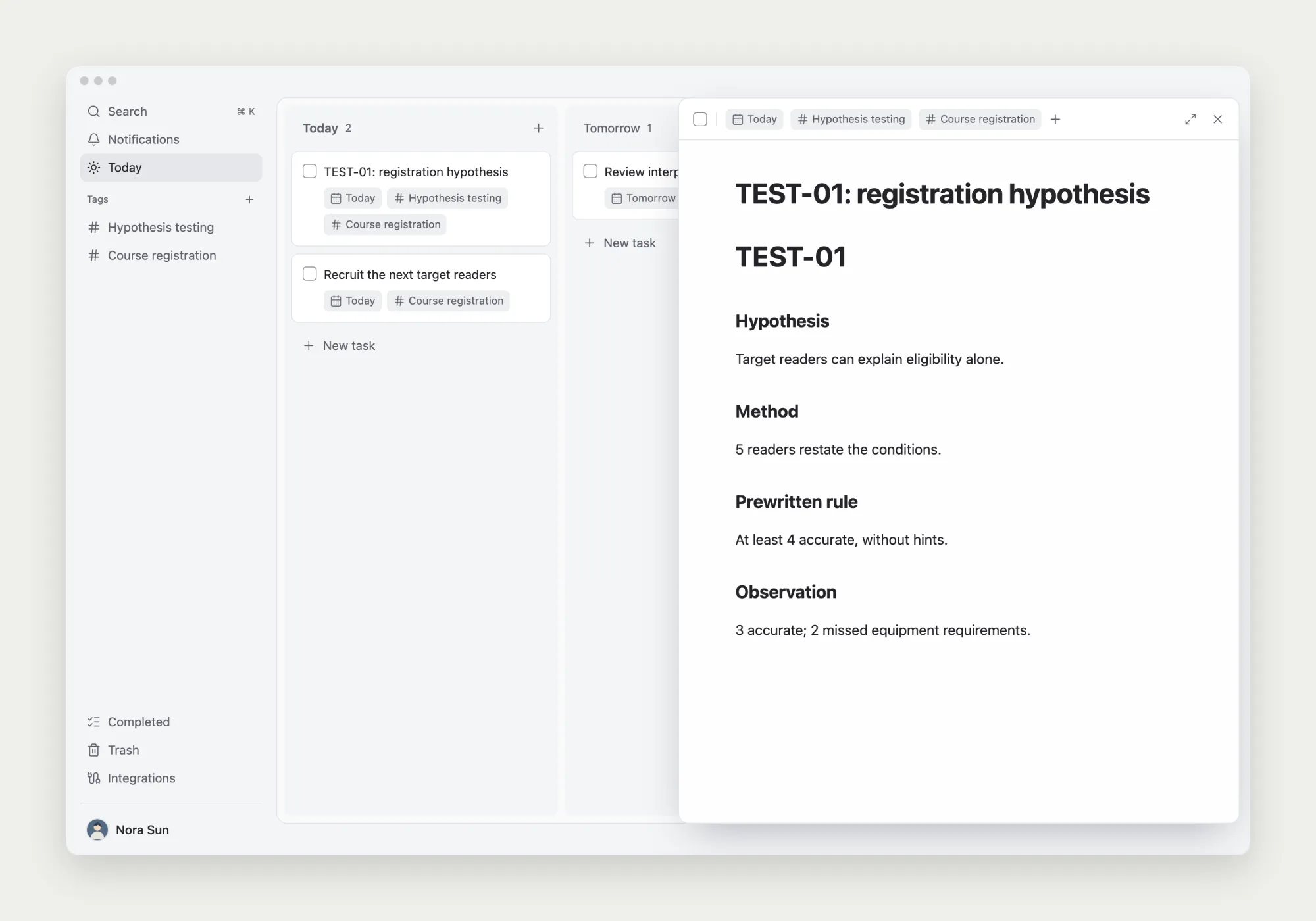
TEST-01 invites five target readers and requires at least four accurate explanations without hints. Three succeed; two omit the equipment requirement. The round therefore misses its predefined continuation condition.
| Observation | Supports | Does not establish |
|---|---|---|
| Three accurate explanations | Performance in this round | Population comprehension rate |
| Two missed equipment rules | A detail worth investigating | A proven single cause |
| Revised text to test next | A next hypothesis | Guaranteed conversion improvement |
Five observations help locate problems but do not estimate a reliable overall conversion rate. Record prior familiarity and other recruitment conditions: an accurate answer may reflect earlier knowledge rather than the page.
Plan the next test without rewriting the first
Inspect wording and placement of equipment requirements, propose a change and test with fresh readers. Keep the original threshold and material. A revised test method belongs to another round, not an edited history.
In TodoNote, retain the card in a task note and use subtasks for recruitment, sessions and review. Project tags connect the rounds. Keep the conclusion in its original record and schedule unverified changes as open work.
Copyable template
Product decision to support:
Main risk:
Hypothesis:
Target participants and recruitment:
Material and version:
Task and instructions:
Measure:
Prewritten threshold:
Continue, revise or stop rule:
Observed results:
Exceptions and missing data:
Supported conclusion:
What remains unknown:
Next round and owner:Background sources: Strategyzer
Related reading: How to Take Usability Testing Notes That Lead to Testable Improvements · How to write a decision log that preserves the reasoning