To review AI-generated work, define what the deliverable will be used for, then verify the facts, sources, dates, comparison terms and calculations that affect its conclusions. Record each important claim alongside its original source, your finding and the required edit. Remove or narrow unsupported statements, and inspect the revised file before you deliver it.
An October 2026 Gallup report found that 63% of surveyed U.S. workers who use AI said it helped them work faster, while 46% reported better work quality. These are employee assessments, not an accuracy test for a particular document. A deliverable still needs a review of the evidence it uses.
Define the decision this document needs to support
Lena is reviewing a comparison of customer-support tools for a small team. The draft already contains prices, plan limits and a recommendation. Its purpose is to shortlist two tools for a trial. That purpose makes eligibility conditions and trial requirements the first review priorities.
Keep the draft filename, generation date and versions of the materials supplied to the AI. Set concrete acceptance criteria: important comparisons have sources, prices use consistent billing terms, and recommendations distinguish documented capabilities from assumptions that need a trial. Readability is another criterion, not a substitute for these checks.
Follow important claims back to their original sources
Open vendors’ own pages for pricing and plan limits. Record the access date and the plan to which each claim applies. For research, check the population, period and measure in the original publication. A working link does not establish that the page supports the sentence. Search snippets and a second AI response cannot replace reading it.
| Item | Review question | Action if evidence is missing |
|---|---|---|
| Price | Are annual equivalents mixed with monthly billing? | Recalculate consistently and state payment terms |
| Feature | Which plan and version include it? | Narrow the claim to its documented scope |
| Data | Do samples, periods and measures match? | Explain differences before ranking |
| Recommendation | Does the evidence support this intended use? | Turn an unsupported conclusion into a trial question |
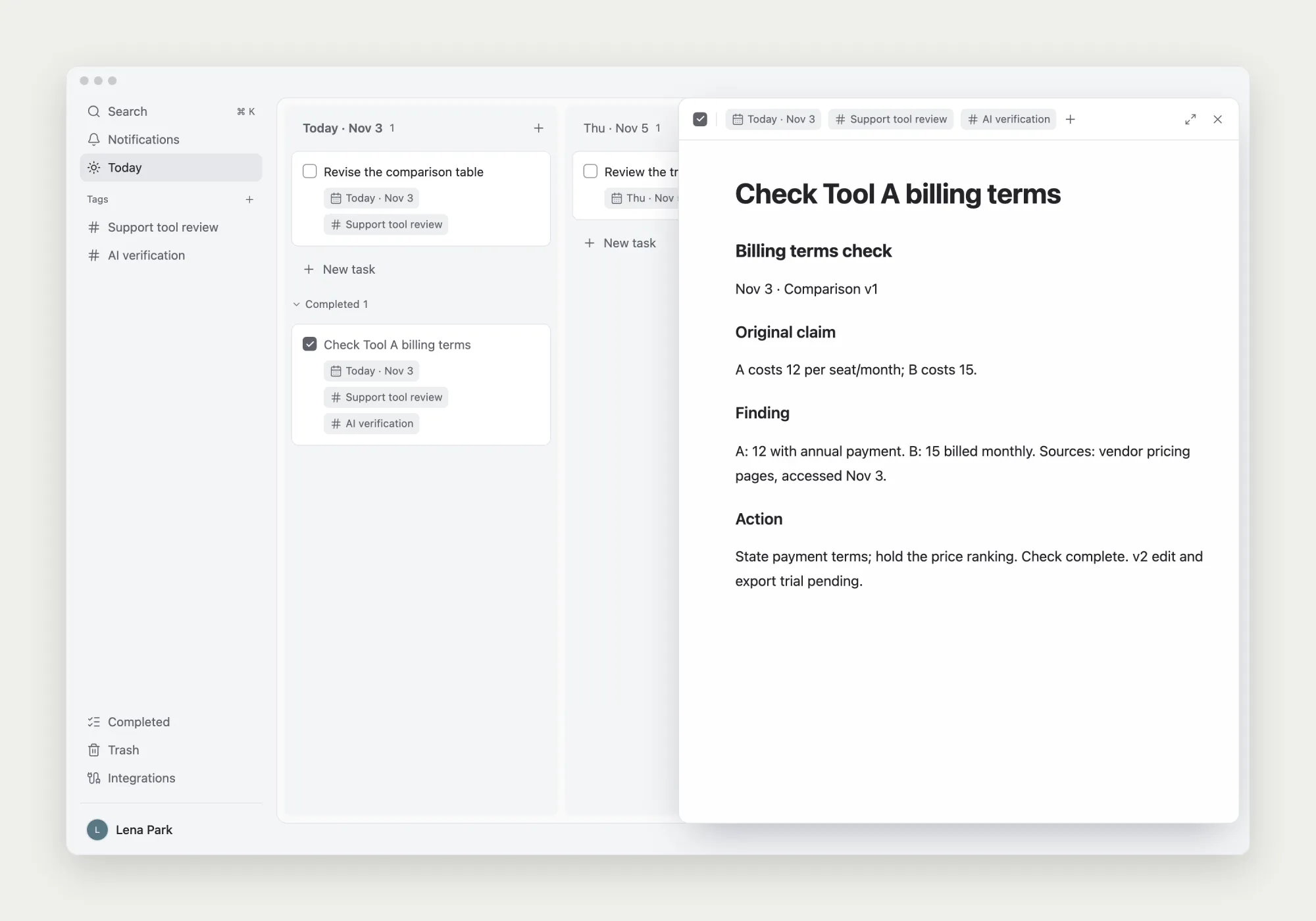
Consider Tool A and Tool B. The draft lists 12 per seat per month for A and 15 for B. A’s 12 requires annual payment, while B’s 15 is a monthly-billed option. Both figures can remain if their payment conditions are explicit. A monthly-billed comparison requires A’s monthly rate as well; the draft does not establish that A is always cheaper.
Track the edit separately from the completed check
In TodoNote, Lena creates a task to check billing terms and keeps the original claim, source location and finding in its note. She completes that check, then schedules the comparison-table edit and final review separately. Finding an error does not update the document or approve the entire comparison.
Recalculate numbers yourself. Check examples against a small input with a known result. For conclusions, distinguish a documented fact, an inference and an expectation you have not tested. A vendor’s support for exports does not establish that migration will work with your attachments and data; that needs a separate trial.
A copyable AI output review checklist
Keep one record for each claim that could change the next action. Group low-impact repetition rather than turning every sentence into a task. The same fields work for proposals, summaries and research briefs.
Purpose / reader / acceptance criteria:
Draft version / generation date / input materials:
Scope of this review:

Original claim / location:
Original source / access date:
Applicable population / version / conditions:
Verification method / actual finding:
Action: retain / correct / remove / leave open
Revised wording / file version:

Missing evidence / owner / follow-up date:
Delivery version / final review date:
Remaining limitations / effect on intended use:Keep uncertainty visible without inventing evidence
If evidence is unavailable, ask whether the claim is essential to the deliverable. Hold the affected recommendation when a critical requirement is unverified. Remove an unnecessary sentence. Make open questions specific: “Does the export include attachments?” provides a useful next step; “check this again” does not.
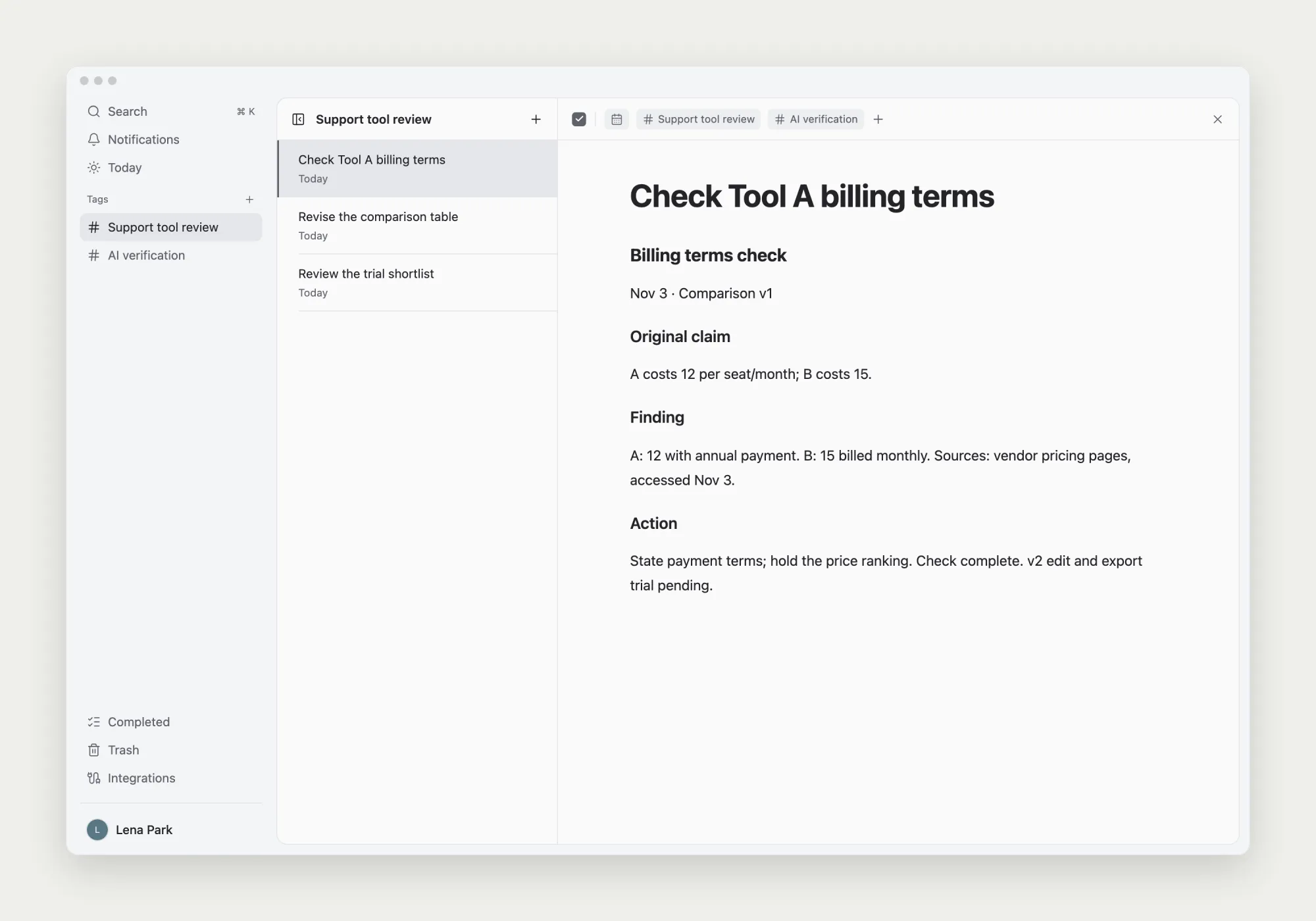
Under the support-tool evaluation tag, Lena can retrieve the completed billing check, the pending edit and the export trial question. Organize that material around future retrieval needs, as described in organizing note tags.
Review the actual file you intend to send
Open the delivery version and confirm that the table, summary and recommendation all reflect the corrections. Recheck citation destinations and repeated numbers. Save the file location and final review date in the note. An error found in the draft may still survive elsewhere in the revised document.
To turn the checked material into a recommendation, use the approach in turning research notes into a decision brief. Keep the original checks as supporting records, then schedule a new review when source pages or selection requirements change.